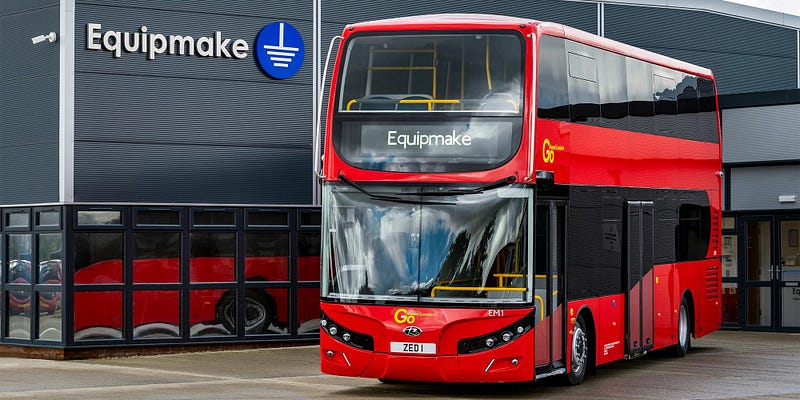
Equipmake, Beulas and Go Ahead London team up for electric double-decker bus trials

Double-decker buses are iconic in London, as they are very popular with tourists. However, these buses are about to get a lot cleaner with the partnership formed between Equipmake and Beulas.

The two companies will make purely electric double-decker buses that will ply routes in the capital city. They will be joined by Go-Ahead London, the largest bus operator in London, who will begin trials of the Jewel E buses early next year.

Equipmake, a British company with more than 20 years of experience, will contribute the powertrain, which includes ultra-high performance electric motors, while Beulas, a Spanish firm based in Girona and has been in the bus business for almost 90 years, will make the coach.

Earlier in September, the partners unveiled the Jewel E electric double-decker bus, which packs a 543 kWh battery for a maximum range of 300 miles on a single charge.

The Jewel E buses will soon enter production in Norfolk, with the UK government aiming to introduce 4,000 electric buses built in the country by 2024. Customers for the buses can choose from 325 kWh, 434 kWh, or 543 kWh battery options, while the electric motor outputs 400 kW and a torque of 3,500 Nm. While the buses are the first to meet the latest Transport for London (TfL) bus safety requirement for 2024, they will also work outside London.

According to Richard Harrington, engineering director at Go-Ahead London:

“At Go-Ahead London, we believe passionately that converting our fleet from internal combustion power to electric energy will deliver a long-term solution to cut emissions and help provide a clean air environment. To date, we have already saved 700 tonnes of CO2 with our existing electric fleet and opened Europe’s first all-electric bus garage, so we have the necessary infrastructure already in place to seamlessly integrate the Jewel E test-program into our services. What makes the Jewel E even more exciting is that it is one of the first EV bus to meet the new Transport for London (TfL) bus safety standard specifications and requirements for 2024, which is a key advantage for our passengers and drivers and the public.”

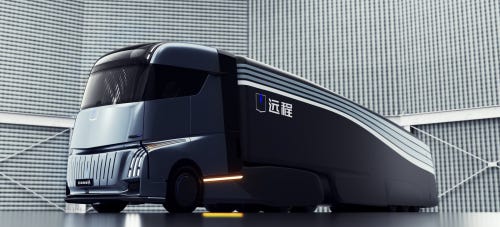
Geely unveils zero-emission truck, Homtruck, with a kitchen and shower

Electric semi-trucks are still a rarity, as the logistics world awaits the promised battery-powered trucks from companies like Tesla and Daimler. Geely Holdings Group, however, has joined the list of automakers promising non-zero emissions with an interesting twist.

The China-based company has unveiled the Homtruck, its smart new alternatively powered semi-truck. This truck offers different powertrain options, including a range extender, methanol hybrid, and pure electric. The last option can also be configured for battery swapping, which means the Homtruck can get a full battery in far lesser time than it would have taken to charge the battery.

The fascinating twist is what the name of the truck is based on. Geely wants to make a truck that feels like home for the drivers, hence, Homtruck. This is why the truck tries to meet the drivers’ emotional and living space needs with its extra features.

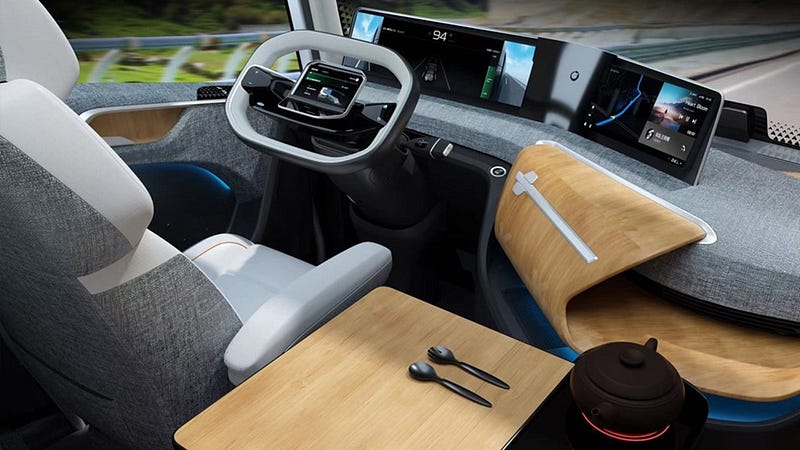
The Homtruck has a cockpit designed to blend driving and living areas. This includes amenities like a shower and toilet, a bed, refrigerator, and even a tea-maker for drivers that love to brew their own cup. There is also a cooking area for drivers to bring their culinary skills on the road. Geely thinks drivers are spending more and more time in their trucks and deserve to be as comfortable as possible.

Supporting the driver is a bevy of assist tech, like AI that works with 360-degree cameras to monitor the surrounding of the truck in real-time, whether stationary or in motion.

There is also autonomous driving, which Geely promised will attain Level 4. This will enable several Homtrucks to platoon and travel together by communicating and maintaining a safe distance from one another. Hardware on board, like lidar, will work with other technologies like 5G and V2X to make the feature happen.

The Homtruck will connect to a command center in real-time, helping the driver obtain orders, track deliveries, calculate operating costs, receive route recommendations, etc. The truck’s energy management technology will also help plan routes around public chargers.

Geely is looking to make the first deliveries in 2024.

Tesla also has its Semi electric truck in the works, although it has not mentioned if it will offer anything besides a day cabin. However, the truck has a similar tech that allows two or more trucks to travel in a close group.

COP26 Updates from Glasgow Scotland: Part 1

World leaders have been meeting in Glasgow, Scotland, to deliberate on climate issues from November 1st. They gather under the banner of the 26th United Nations Climate Change Conference, COP26. So far, many speakers from different nations have given addresses, and we have seen them commit to climate goals.

For example, Indian Prime Minister, Narendra Modi, has revealed his country is working toward a 2070 net-zero carbon emission target. However, much earlier in 2030, India plans to have converted half of its energy sources to renewables and increase its clean energy capacity to 500 GW. Modi also called on developed nations to put up $1 trillion to fund climate efforts.

Nigeria is even more ambitious than India, pledging to achieve net-zero emission ten years faster. Africa as a continent contributes the least emissions globally, at 3%. The countries promised to spend not less than $6 billion per year for the next five on climate goals.

Brazilian President Jair Bolsonaro, who wasn’t in attendance but sent a pre-recorded speech, extolled his country as a player in solving climate problems.

President Joe Biden of the US affirmed his country’s commitment to reducing carbon emissions by 50% by 2030, using 2005 as a baseline. He also assured other world leaders that the US is back to leading the discourse on climate change. The President has also unveiled a plan to cut methane emissions globally by 30% by 2030, with 89 other countries, including Brazil. In addition, the US has rejoined the High Ambition Coalition to ensure the 1.5C goal that was a vital part of the Paris Agreement.

The world leaders in Glasgow have also committed to a pledge to end and reverse deforestation. Brazil is in focus in particular, as its Amazon forests have witnessed severe deforestation in recent times. Other countries joining are Canada, Russia, China, the Democratic Republic of Congo, the US, and the UK. Altogether, the pledge affects about 85% of forests globally. The commitment also includes a $19 billion fund to support the effort.

Apart from political leaders, players in the banking and pension fund markets have formed a pledge of their own, known as the Glasgow Financial Alliance for Net Zero, GFANZ. Participants have promised that by 2050, all the assets they manage will be aligned with net zero-emission goals.

Tesla finally allows all electric vehicles to use its Superchargers

In what is a big win for electric vehicles globally, the number one electric car maker, Tesla, has begun opening its Superchargers to all EVs. Previously, only Tesla-branded cars could use the fast chargers.

True to the words of the CEO, Elon Musk, Tesla has started welcoming all EVs to its more than 25,000 chargers worldwide. But it is rolling out the access in phases, beginning with the Netherlands.

Non-Tesla drivers will download the Tesla app to charge. The process requires more steps for them, as they have to set the charging to start and stop, unlike the seamless experience Tesla owners enjoy. When the car charges slowly, Tesla will charge them more to compensate for holding up the stall.

Tesla has also indicated it will implement a kind of price surge, where it will charge more during rush hours to make better use of electricity.

In Europe and China, Tesla won’t need extra hardware for non-Tesla cars to use the Superchargers because all the electric vehicles use the same charging standard. It only has to tweak its software. However, the story is different in North America, where Tesla uses a proprietary connector. The company says it will provide adapters at its public stations, which drivers can also purchase.

For many years, non-Tesla drivers could only drive past Superchargers which are among the best maintained public chargers. However, with this move, Tesla will now conform with the aims of its CEO, who wants to promote electric cars globally to combat environmental pollution. According to him, Tesla does not compete with other EV makers but with internal combustion engine cars.

Tesla will continue to expand the public charging network, especially now that more vehicles will be making use of the chargers.

Details of the global rollout will come over the coming months.

Hertz orders 100,000 electric vehicles from Tesla for $4.2 billion

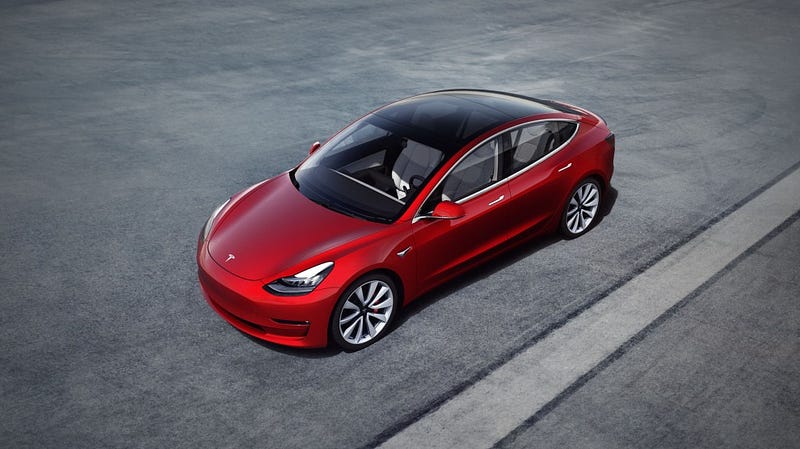
Tesla Model 3, courtesy of Tesla

Car rental companies have some of the largest vehicle fleets globally. For example, Hertz has about 500,000 vehicles, all of which produce carbon emissions from their tailpipes. However, Hertz is making moves to transition to an electric fleet and has taken a huge by ordering 100,000 electric vehicles from Tesla for $4.2 billion.

The order is made up of Tesla’s Model 3, and they will be available for lease starting in November in the US and Europe. Tesla will make all the deliveries in 14 months.

Hertz will install public chargers, in addition to Tesla’s network of Superchargers. They will include both Level 2 and DC chargers and cover more than 100 countries by the end of 2023.

It has been a wild few years for Hertz, who went bankrupt last year but got bought out by a debt managing company.

Almost immediately after announcing the deal, Hertz and Uber entered into an agreement to lease 50,000 electric cars to drivers on the ride-hailing platform in the US. Uber drivers will pay a weekly amount to use the Model 3 for ferrying passengers.

This deal is a big win for the environment. Apart from taking out thousands of ICE cars from operation, it will make electric cars more available to renters who might be trying them out for the first time. If impressed, the renters can make electric cars their next purchase.

This is the second time an EV maker will get a massive order as online retail giant Amazon in 2019 agreed to buy 100,000 electric vans from Rivian to make package deliveries to its millions of customers.

Tesla has also had an exciting year, with its stock jumping above the 1000 dollar mark at the news of Hertz’s deal, pushing its market capitalization above $1 trillion, by far the most for any car maker. With two new factories near completion in the US and Germany, the American company should have enough capacity to deliver on Hertz’s order.

The Model 3 is the best-selling electric car ever made, and Tesla makes them in the US and China. The company has plans for an electric pickup truck, the Cybertruck, and a class 8 electric truck, the Semi.

Powertis to develop 99 MW solar project in Colombia

Renewable energy is catching on globally, with news out of Colombia indicating that power production is getting cleaner. Powertis, a company that makes solar panels, has been awarded a 99 MW development project. The company won a portion of the renewable energy auction put by the country’s Ministry of Mines and Energy.

The project will be hosted in the Antioquia region and will supply the Uraba 110 kV substation. The total output from the site is 135 MW.

With 99 MW allocated to Powertis, the company got more than 12 percent of the projects handed out by the ministry. Eleven other companies each took a slice of the pie.

Pablo Otín, CEO of Powertis, said, “We are very satisfied with the result of this auction. With this new step, we continue to strengthen the company’s positioning and commitment in Colombia, which is one of the markets in which we are expanding our business. This milestone represents a great opportunity for growth and development both for us and for the country, which, after this energy auction, takes another step forward in the consolidation of the energy transition”.

Powertis will use this new project to increase its presence in the South American country.

About Powertis

Powertis is a company dedicated to the development of photovoltaic energy projects, with a presence in Spain, Italy, Brazil, Denmark, Colombia, and the US. Founded in 2018, it belongs to the Soltec Power Holdings group and its mission is to develop solar energy with efficiency, excellence, respect for the environment, as well as ensuring the full integration of local communities, by creating jobs in development, structuring, financing, construction, operation and maintenance of the plants.

Germany to increase its funding of private home charger installation with €300 million

Germany is home to some of the top players in the automobile industry. However, despite their extensive legacies in making ICE cars, most of them are switching to full-time electric production, with Volkswagen establishing itself in front of the pack.

The German government continues to support these electrification efforts by helping to expand EV charging infrastructure in the country. It will do this by adding €300 million to the €0.5 billion it had already earmarked for partially funding the purchase and installation of wallbox chargers in private homes.

This new addition brings the total amount available for the purpose to €800 million.

Homeowners can get a grant of €900 towards installing chargers at home. From the inception of the grant scheme to July 2021, the government received more than 600,000 applications.

Apart from private homeowners, apartment owners’ associations, housing companies, and property developers are eligible to apply for the grant. It applies to the purchase and installation of new charging stations and their connection to the grid.

Germany is trying to kill two birds with a single stone with this grant because of the conditions; 100% of the power supply to the home charging stations must be renewable. Other conditions include a cap of 11 kW, and the chargers must be smart and remotely controllable. The cost of the project must be over €900 to qualify.

Applicants will get the funds only after the installation has been completed when the money will be transferred to their bank account.

According to Federal Minister of Transport Andreas Scheuer, “Starting tomorrow, German citizens can again secure a 900 euro grant from the federal government for their own charging station at home. Over half a million applications show the enormous demand for this funding. I would like to thank Olaf Scholz, who has made a further 300 million euros available to us so that we can continue our wallbox funding. Charging must be possible anywhere and anytime. A nationwide and user-friendly charging infrastructure is a prerequisite for more people to switch to climate-friendly e-cars.”

Tesla marks 1000th Supercharging Station in China

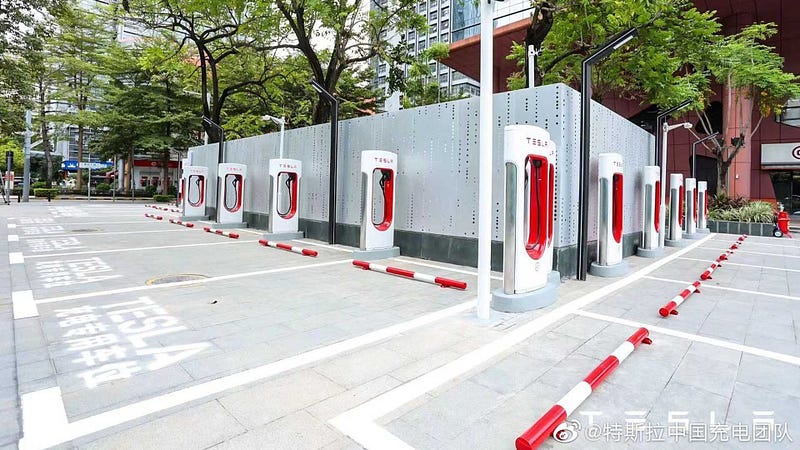
While Tesla is increasing its production facilities in China, the company is not forgetting to build out infrastructure to support the EVs in the country. As a result, China is fast becoming one of the best places to own and operate a Tesla car because of the availability of charging stations. Tesla just opened its 100th Supercharger station and 1000th charging stalls in mainland China.

The landmark station is located in the Iconic Sky City Rafael site in Shanghai. To mark the occasion, Tesla China released a message that translated to “Travel conveniently with 100 Supercharging Stations and 1000 stalls that offer efficient charging. Enjoy pure electric.”

This milestone is not surprising, given that Tesla China now makes Superchargers in its Giga Shanghai facility, which can produce 10,000 units per year. This shows how far Tesla has come from April 2014 when it installed the first Supercharger in Jinqaio Town.

Tesla has the most extensive presence globally on the EV charging scene, with more than 25,000 charging points. A V3 Supercharger can add 250 km to the Model 3 in 15 minutes.

In June, Tesla completed the Silk Road Supercharger line, a stretch of more than 5,000 km from east China to the west.

Apart from Superchargers, Tesla has over 700 destination charging stations that contain 1,750 charging poles.

With the signals coming from Tesla, other non-Tesla electric vehicles will eventually use these Superchargers. Elon Musk, the CEO, has confirmed his company is working on opening up these chargers to all EVs, a significant boost to the spread of electric vehicles globally.

There are other charging networks in China, and some EV makers like NIO are building battery swapping stations, a faster but more technical way to get a full battery.

EV charging infrastructure is crucial to the adoption of EVs as governments promote them to combat environmental pollution.

China has become a hot spot for innovations and electric vehicle production, and many automakers are setting up operations because of the extensive supply chain. Ford, Daimler, Volkswagen, etc., all operate manufacturing facilities in the Asian country.

Very cheap models like the Wuling Hong Guang EV and more expensive models like the Tesla Model 3 and Zeekr 001 compete for local and global sales.

Saudi Arabia to build world largest battery energy storage system

Courtesy of Huawei

Saudi Arabia has been making huge strides in renewable energy, and it is complementing them with a battery energy storage system that will be the biggest in the world. The Gulf nation has awarded the contract to build the energy system to Huawei.

In turn, Huawei will partner with fellow Chinese company SEPCO111 on the Red Sea Project.

When completed, the battery energy storage system will have a storage capacity of 1,300 MWh and be hooked up to a 400 MW solar farm that local company ACWA Power is building.

Huawei has installed more than 8 GWh of battery system globally and will bank on its experience to deliver the project.

Saudi Arabia has selected a site for the project in NEOM, in the Tabuk Province. It is part of the nation’s plan to make NOEM a smart city. NOEM is entirely built from scratch and will rely completely on renewable energy like solar and green hydrogen.

This project is a good development for a country that is heavily dependent on revenue from hydrocarbon fuels. It shows Saudi Arabia’s seriousness about shifting to renewable energy both in its power generation and economy.

“This 1300 MWh off-grid energy storage project is the largest of its kind in the world and represents a milestone in the global energy storage industry,” Huawei said in a statement.

Dubai is building an 8.61 MWh energy storage system in the same region through its Dubai Electricity and Water Authority (DEWA). The project is located at the Mohammed bin Rashid Al Maktoum Solar Park and uses Tesla’s lithium-ion batteries.

South Korea to spend $10 billion to cut emissions by 40% by 2030

Courtesy of Times of India

South Korea has upped its emission reduction target to 40% by 2030. This is a significant improvement over the Asian country’s target of 26.3% set in 2020. Both targets use 2018 emission levels as a base.

This new environmental goal was announced by the president of South Korea, Moon Jae-in, during a committee meeting on achieving carbon neutrality.

South Korea presently gets over 40% of its electricity from coal-powered stations, with only 6% coming from clean sources. The country’s manufacturing industry is heavily dependent on fossil fuels. This shows the great challenge South Korea will face in achieving the target.

Part of the strategy is to cut coal-plant generated power by half by 2030 and increase renewable energy share to 30.2%. It will also see 4.5 million vehicles powered by batteries and hydrogen on the road by 2025. Infrastructure for charging electric vehicles will also receive attention.

To reach the emission reduction goal, South Korea has earmarked about $10 billion. The goal for net-zero by 2050 is still in place, but it would be welcome if brought backward.

Back in 2020, President Moon Jae-in revealed the Green New Deal, which aimed to create new jobs and help the country recover from the effect of the pandemic.

President Moon Jae-in described the move, “This is the most ambitious reduction target possible under our circumstances. The goal of cutting greenhouse gas emissions [by] 40% shows the nation’s strong willingness for carbon neutrality and responsibility toward the international community.”

This ambitious announcement comes ahead of the UN’s COP26 summit taking place in Glasgow, Scotland. It will start on October 31. The conference will try to get more ambitious action plans from participating countries on limiting global warming.