

While Tesla is increasing its production facilities in China, the company is not forgetting to build out infrastructure to support the EVs in the country. As a result, China is fast becoming one of the best places to own and operate a Tesla car because of the availability of charging stations. Tesla just opened its 100th Supercharger station and 1000th charging stalls in mainland China.
The landmark station is located in the Iconic Sky City Rafael site in Shanghai. To mark the occasion, Tesla China released a message that translated to “Travel conveniently with 100 Supercharging Stations and 1000 stalls that offer efficient charging. Enjoy pure electric.”
This milestone is not surprising, given that Tesla China now makes Superchargers in its Giga Shanghai facility, which can produce 10,000 units per year. This shows how far Tesla has come from April 2014 when it installed the first Supercharger in Jinqaio Town.
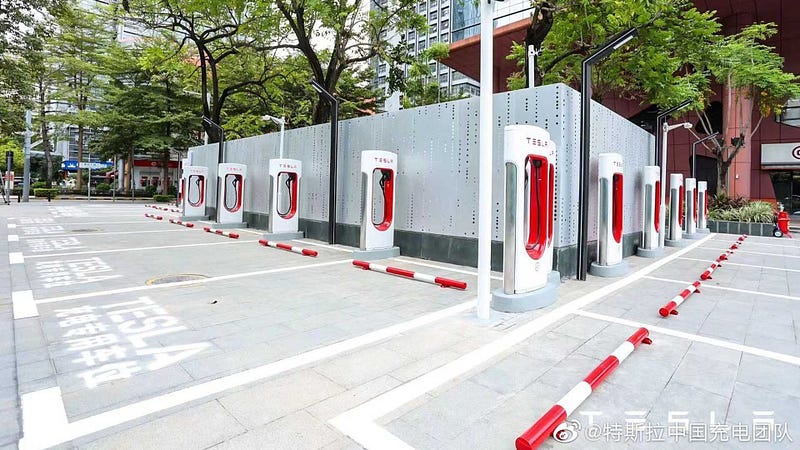
Tesla has the most extensive presence globally on the EV charging scene, with more than 25,000 charging points. A V3 Supercharger can add 250 km to the Model 3 in 15 minutes.
In June, Tesla completed the Silk Road Supercharger line, a stretch of more than 5,000 km from east China to the west.
Apart from Superchargers, Tesla has over 700 destination charging stations that contain 1,750 charging poles.
With the signals coming from Tesla, other non-Tesla electric vehicles will eventually use these Superchargers. Elon Musk, the CEO, has confirmed his company is working on opening up these chargers to all EVs, a significant boost to the spread of electric vehicles globally.
There are other charging networks in China, and some EV makers like NIO are building battery swapping stations, a faster but more technical way to get a full battery.
EV charging infrastructure is crucial to the adoption of EVs as governments promote them to combat environmental pollution.
China has become a hot spot for innovations and electric vehicle production, and many automakers are setting up operations because of the extensive supply chain. Ford, Daimler, Volkswagen, etc., all operate manufacturing facilities in the Asian country.
Very cheap models like the Wuling Hong Guang EV and more expensive models like the Tesla Model 3 and Zeekr 001 compete for local and global sales.




 Renewable Brief